
Awareness VR
Project Background
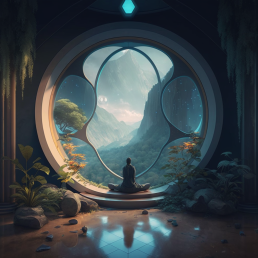
This capstone project explores the user-centered design of a virtual reality application that helps people start meditating and develop a consistent practice.
Problem
Meditation offers numerous well-documented benefits beyond relaxation, yet in my experience, few people practice it and even fewer maintain a consistent practice.
My Role
- UX Research
- UX Design Concept
- Prototyping
- Usability Testing
Duration: Jan – Mar 2023
Stakeholders: UX design supervisor and peers


Design Process

UX Research
My research questions
- What are people’s current understanding of meditation?
- Why are people interested in starting a meditation practice?
- What are the barriers that keep people from starting meditation?
- What are the reasons people stop after they have tried meditation?
- What are some objects, sounds, and environments that people associate with focus and calm?
Methodology used
- Semi-structured interviews
- Competitive Analysis
Deliverables
- Affinity Mapping Diagram
- Key Findings and Design Consideration Report
- Persona Empathy Map
Key Findings from Interviews
Theme
Category
Example
Current Perceptions of Meditation
Mental Exercise
Participants compared meditation to physical exercise, viewing it as a workout for the mind.
Introspection & Presence
Participants identified increased self-awareness and present-moment awareness as key benefits of meditation.
Focus & Calm
Participants associated meditation with peace, calmness, and improved focus when asked about meditation.
Current Practice
Guided Meditation
Breath & Body
All participants had practiced mindfulness meditation using breath awareness or body scanning techniques.
Consistency
None of the participants maintained a consistent meditation practice, though all expressed a desire to meditate more frequently.
Barriers
Procrastination
All participants identified personal behaviors such as procrastination, self-sabotage, and lack of motivation as their primary barriers to meditation.
Time
Participants claimed time constraints prevented meditation, yet admitted not practicing even during free time.
Lack of Understanding
One participant feared improper meditation could harm their mind, while others believed meditation required suppressing all thoughts and keeping eyes closed.
Helpful Features in a Meditation App
Tracking
Participants felt motivated when tracking their meditation sessions in a calendar format.
Series
Two participants preferred guided meditation courses that progressively built on previous sessions.
Reminders
One participant found in-app reminders helpful in maintaining their meditation practice.
Environments
Personal Space
Participants preferred practicing meditation at home.
Nature
Participants also expressed interest in meditating in natural settings.
Sounds
Water
Multiple participants found rainfall and waterfall sounds soothing.
Birds
Participants found bird sounds calming
Competitive Analysis
Summary
This study examined two meditation applications: Waking Up and TRIPP. Waking Up offers expert-led meditation content rooted in ancient wisdom, modern science, and philosophy. TRIPP, on the other hand, introduces users to meditation through gamified experiences in virtual and real-world environments, leveraging rewards, personalization, and community features to encourage regular practice. Currently, no meditation app combines the depth of expert-led content with engaging virtual experiences. (Click here for full analysis)

Problem Statement
How might we motivate people to start and maintain a regular meditation practice?
Design Considerations
Progress Tracking
Incorporate progress tracking to support user motivation and practice consistency.
Bigger Context
Highlight the holistic benefits of meditation through progress tracking and insights to sustain user motivation.
Sounds
Integrate ambient nature sounds, particularly rainfall and waterfalls, to enhance the calming experience
Environments
Create environments that simulate both private spaces and natural settings to accommodate user preferences.
Limit Movements
Minimize visual movement to reduce user distraction during meditation sessions.
Accountability
Incorporate social accountability features, such as group meditation sessions, to encourage consistent practice among beginners.
Delayed Start
Include a 40-second buffer before guided meditation begins, allowing users to acclimate to the virtual environment.
Starting Ritual
Create a transitional experience that prepares users for meditation practice.
Clear Start and End
Incorporate meditation bells as audio cues to mark the start and end of each session.
Calming Colors
Employ a color palette that evokes calmness and tranquility.
Field of View


Ideation
Divergent Thinking Approaches Utilized
- Sketches
- Moodboards
- Mindmaps
- Storyboards


Ideation process highlights
Iterative Prototyping
In-person and remote usability testing with VR headsets was conducted on low and high-fidelity prototypes to inform design improvements.
Low Fidelity Prototype
Navigation Menu
- Labels: Participants were less likely to interact with meditations with unfamiliar labels.
- Home Screen: The number of options available on the home screen could overwhelm a new user.
- Motivation: Participants thought the tracking features would motivate them to be consistent.
Meditation Experience
- Closed Eyes: Participants found the environment overly bright and lacking dynamic elements, which reduced engagement. They associated meditation with closed eyes, reflecting their experience with traditional methods.
- Guided Instructions: While participants appreciated the pauses between guided instructions, they found the background sounds distracting.
- Subtle Ambient Sound: Participants thought subtle ambient sounds aligned with the environment would enhance immersion without causing distraction.


High Fidelity Prototype


Lessons Learnt
- Currently, limited software options exist for rapid prototyping and testing of VR experiences.
- VR text legibility depends on the correct angle and distance from the user’s viewpoint.
- Users tend to disengage from meditation apps with static environments, while subtle movement and sound can create engaging experiences that encourage return visits.
- The VR experience must be optimized to prevent lag from slower internet speeds, as loading delays can cause motion sickness.
Future Work
- Incorporate subtle movements and dynamic elements to enhance immersion without causing distraction.
- Support consistent practice through additional features:
- Journaling
- Custom reminders
- Integrate haptic feedback and scent elements to deepen learning and immersion.”


References
-
- Gazzaley, A. (n.d.). The Distracted Mind: Ancient Brains in a High-Tech World.
- Goleman, D. (n.d.). Emotional Intelligence: Why It Can Matter More Than IQ.
- Goleman, D., & Davidson, R. J. (2018). Altered Traits: science reveals how meditation changes your mind, brain, and body. Avery, An Imprint Of Penguin Random House Llc.
- Meditation and Mindfulness: What You Need To Know. (n.d.). [National Institutes of Health]. National Center for Complementary and Integrative Health. https://www.nccih.nih.gov/health/meditation-and-mindfulness-what-you-need-to-know
- Seabrook, E., Kelly, R., Foley, F., Theiler, S., Thomas, N., Wadley, G., & Nedljkovic, M. (n.d.). Understanding How Virtual Reality Can Support Mindfulness Practice: Mixed Methods Study. https://www.ncbi.nlm.nih.gov/pmc/articles/PMC7113800/
- Meija, Z., & Spann, Ph.D., R. T. (n.d.). 10 Science-Backed Benefits Of Meditation. https://www.forbes.com/health/mind/benefits-of-meditation/
- Keely. (n.d.). Meditation Statistics: How & Why People Meditate. Mellowed. https://mellowed.com/meditation-statistics/
- 10 Rules of Using Fonts in Virtual Reality. (n.d.). http://vovakurbatov.com/articles/10-rules-of-using-fonts-in-virtual-reality
- Simple Low-Fidelity VR Prototyping: Practical How-To Advice. (n.d.). https://blog.prototypr.io/https-medium-com-michael-c-albers-simple-low-fidelity-vr-prototyping-practical-how-to-advice-a976bd0cdcbf
- UX 101 for Virtual and Mixed Reality—Part 1: Physicality. (n.d.). https://uxplanet.org/ux-101-for-virtual-and-mixed-reality-part-1-physicality-3fed072f371
- VR Usability. Part 2. (n.d.). https://medium.com/silicon-valley-global-news/vr-usability-part-2-b89aede8e402